A simple, unaligned memory allocator
I took some time recently to write a simple memory allocator, and thought I’d write here the things I thought interesting. That’s mostly so that I can come back in a while and recall all this, but maybe you’d find it interesting too.
This post assumes you’re familiar with a basic memory allocator, and some C++. If not for the former, you might be interested in “Operating Systems: Three Easy Pieces”, ch. 17 “Free-Space Management”.
A working version of all this code can be found here.

A simple, unaligned allocator
Below is a very simple program with a malloc and free which can be used to allocate memory out of a contiguous 4096-sized address space:
constexpr std::size_t heap_size = 4096;

// This gets allocated in static space. It's basically equivalent to an MMAP.
char heap[heap_size] = {};
We want usage to look something like this:
// First one: gets its a memory range after the heap's header.
void* p1 = specialmalloc(sizeof(int));
int* x1 = new(p1)int{42};
*x1 += 1;
std::println("{}", *x1);

// Second one: gets a memory range after the first.
void* p2 = specialmalloc(sizeof(int));
int* x2 = new(p2)int{11};
std::println("{}", *x2);

specialfree(p1);
specialfree(p2);
What do we want that code to do?
So essentially we have a 4096 byte range and we want to hand out slices of it to
code that calls specialmalloc, and give them a specialfree to return it to
our ownership.
Whenever we hand out some bytes, we need to prepend a small manifest (“header”) before it which describes what follows. We also need to add a small manifest at the start and end of our heap so that we can notice when we’re near the start/end.
struct header {
    int len = 0;
    bool used = false;
    bool header = false;
    bool footer = false;

    constexpr static int size() {
        return sizeof(len) + sizeof(used) + sizeof(header) + sizeof(footer);
    }
};

header read_header(std::span<const char> bytes) {
    header out;
    std::memcpy(&out.len, bytes.data(), sizeof out.len);
    std::memcpy(&out.used, bytes.subspan(sizeof(out.len)).data(), sizeof out.used);
    std::memcpy(&out.header, bytes.subspan(sizeof(out.len)+sizeof(out.used)).data(), sizeof out.header);
    std::memcpy(&out.footer, bytes.subspan(sizeof(out.len)+sizeof(out.used)+sizeof(out.header)).data(), sizeof out.footer);
    return out;
}

void write_header(std::span<char> bytes, const header& h) {
    std::memcpy(bytes.subspan(0).data(), &h.len, sizeof(h.len));
    std::memcpy(bytes.subspan(sizeof(h.len)).data(), &h.used, sizeof(h.used));
    std::memcpy(bytes.subspan(sizeof(h.len)+sizeof(h.used)).data(), &h.header, sizeof(h.header));
    std::memcpy(bytes.subspan(sizeof(h.len)+sizeof(h.used)+sizeof(h.header)).data(), &h.footer, sizeof(h.footer));
}
You might have already noticed that we are doing zero alignment here. We’re
intentionally NOT doing sizeof(header) which would return 16, and instead
doing header::size() which would return 8. And similarly we’re intentionally
mapping individual fields at their exact sizes rather than the entire struct.
We’re going to talk about alignment in the next article.
A simple malloc and free
Let’s write a really simple implicit free list malloc, where we just write
header{.header=true}, header{.len=xyz, .used=true}, payload,
header{.len=xyz, .used=true}, payload, …, header{.footer=true}.
And, let’s forget about splitting and coalescing. We’ll start really simple.
Here’s what our malloc and free look like:
void* specialmalloc(int size) {
    if (size <= 0) return nullptr; // junk request
    int offset = 0;
    header h;
    while(true) {
        offset += header::size();
        h = read_header(std::span(heap).subspan(offset));
        if (h.footer == true) {
            return nullptr;
        }
        bool enough_space_in_heap = offset + header::size() + size <= heap_size - header::size();
        if (h.len == 0 && !enough_space_in_heap) {
            return nullptr; // Not enough space in heap.
        }
        bool unused = !h.used;
        bool enough_space = h.len == 0 || h.len >= size;
        if (unused && enough_space) {
            break; // Got a spot: break and use it.
        }
        offset += h.len;
    }
    // If the pre-existing len is larger, we need to keep the larger size so
    // that we can continue jumping over it.
    int len = (h.len == 0) ? size : h.len;
    write_header(std::span(heap).subspan(offset), header{.len = len, .used = true});
    offset += header::size();
    return &heap[offset];
}

void specialfree(void* ptr) {
    if (ptr == nullptr) return; // Junk request.
    uintptr_t addr = (uintptr_t)ptr;
    uintptr_t base = (uintptr_t)heap;
    uintptr_t offset = addr - base - header::size();
    header h = read_header(std::span(heap).subspan(offset));
    h.used = false;
    write_header(std::span(heap).subspan(offset), h); // We could just directly bit flip too.
}
Viewing this with ImHex
ImHex is a really neat little tool for viewing the bytes we’ve allocated:
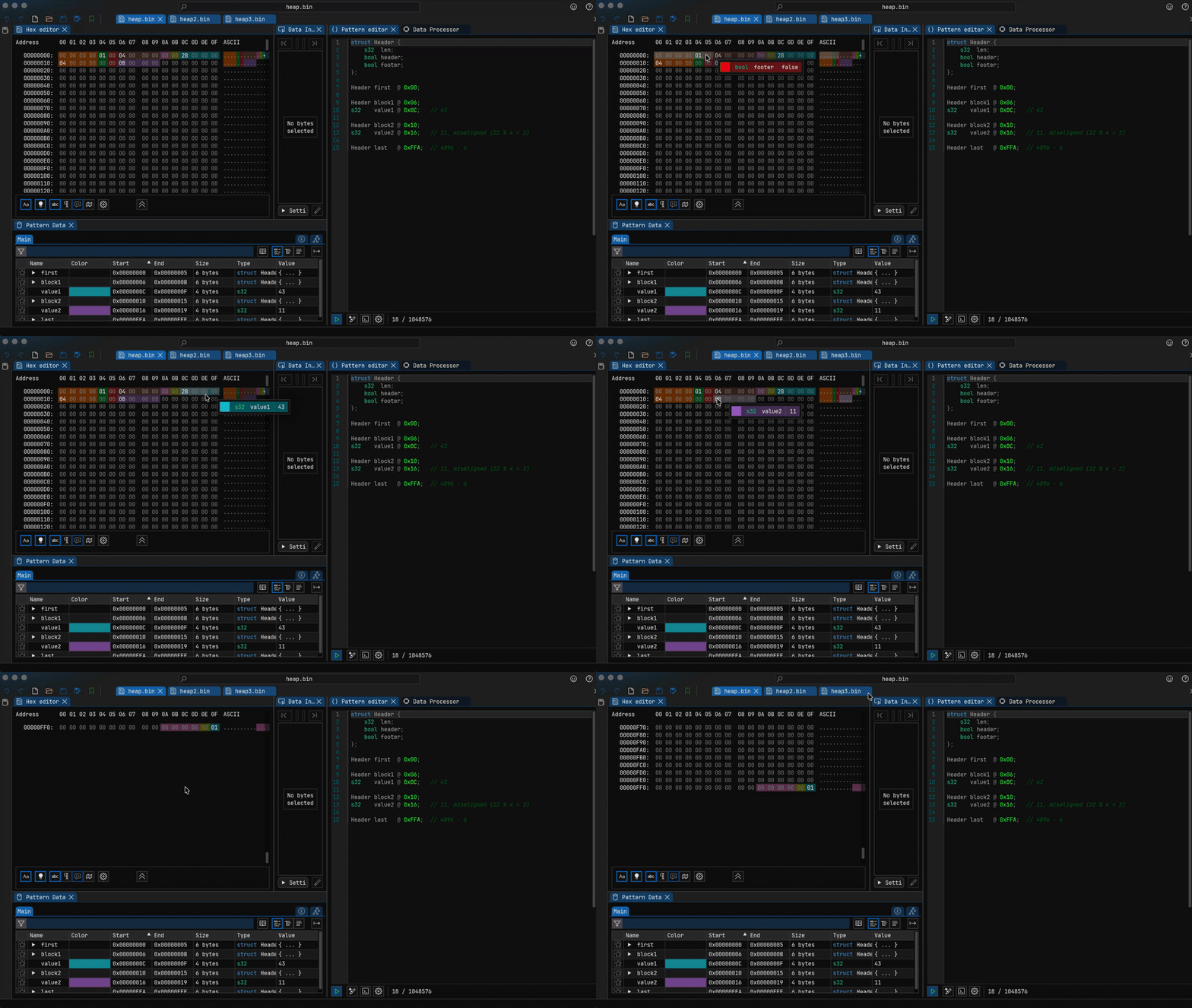
(Note: this gif taken before adding the used bool, so you won’t see that)
This neatly shows the byte space being used by our heap, and the tight bit packing achieved.
In this image, two ints were allocated and no free was called. If we called free on both pointers and allocated a new int, the first pointer’s space would get re-used and the second pointer would just be marked used=false without zeroing out its space.
Next up
In the next post we’ll talk about the alignment issues here, and fix it. We’ll also discuss splitting and coalescing that we might want to do.