LSCs, AI agents, and determinism
Large scale code changes (LSCs) are groups of code changes that all try to accomplish the same goal, across a huge number of codebases.
For example, a common LSC is to migrate all codebases at a company from libraryX@v1 to libraryX@v2, changing code along the way to account for differences in API between v1 and v2. Due to their breadth, LSCs have high cognition cost, owing to the high amount of contexts you have to reason about. But also due to their breadth, they tend to have bounded problem spaces: the wider a change has to be applied, the more generic the change must be. A change that can’t be generically expressed is not an LSC, but instead a series of individual changes.
AI agents are one way to attempt to tackle LSCs. Goals can be expressed generically and handed to AIs as prompts to work on all target codebases. But, when AI agents are set loose to perform LSCs, LSCs’ high cognition cost compounds with AI non-determinism to result in low confidence in the changes being applied, incur high costs, and produce results which are unauditable.
This article presents a different approach, based on a simple observation: most changes that can be expressed generically can also be expressed mechanically. AI agents explore and solve the LSC’s problem space in an evaluation flywheel, and encode their results in a metaprogramming program which itself is used to perform the LSC in a way that is deterministic, leads to higher confidence, is cheap, and is as auditable as ordinary source code.

Context
At Google and now at Netflix, I find myself frequently having to perform large
scale changes to code: changes to hundreds or thousands of codebases. For
example, at Google, when I rewrote the internal Go status library (similar
external version
here) to support Go
1.13 error wrapping/unwrapping, Google’s
internal one-version-of-every-library + monorepo setup meant that I had to also
go make this work for ~56k Go programs. That involved making changes to hundreds
of programs with non-conforming / Hyrum’s-Law type oddities at the same time.
Most recently at Netflix, I’ve been working on problems requiring LSCs over our thousands of Go projects. An example recent, long-running LSC is periodic remediation of vulnerable dependencies.
Doing this kind of work in 2026 is dramatically faster with AI Agents, but surprisingly there’s a good lesson to be learned from the old way of doing it which can be paired with AI agents.
Before AI agents, we used to perform these changes by hand, and quickly learned instead to build metaprogramming programs: programs which modified programs.
With AI agents, it’s natural to think to replace this with hordes of AI sub-agents performing code change on each repository, with some shared prompt or goal. However, it turns out to still be more advantageous to write a program for the LSC, albeit now with an AI agent to explore the problem space and encode the solution into that program.
The end result is a small program which, when run on all the target repositories, solves the LSC goal in a deterministic, cheap, and auditable manner.
Let’s take a look in closer detail.
Evaluation framework
This technique starts with an evaluation framework and a discovery / actuate / evaluate loop. Using the vulnerability remediation project above, the evaluation framework is largely self-evident. The goal is to remediate all Go repositories of vulnerable dependencies. For each repository,
- Go’s govulncheck reports whether there are any vulnerabilities. (Goal: 0 fixable vulnerabilities)
- The output and exit code of whatever program we write tells us whether we were successful, and if not what failed. (Goal: no failures)
- A PR’s CI/CD log tells us whether a PR to perform that remediation is valid, and if not what failed. (Goal: valid PR)
This is all we need to begin our loop.
Discovery loop
With a sufficiently large enough set of repositories (which we have at Netflix, or is generally available in GitHub), and enough compute, and enough tokens, and a bounded problem space, we can solve the problem space and produce a single solution.
We produce a solution to the problem space in the form of a program. That program remediates vulnerabilities in whatever repository it is run in.
We encode the problem space, as we discover it, as a series of txtar tests. That becomes the early signal in our evaluation framework; it doubles up as a regression test mechanism; and it triples up as audit documentation (This is how the program is built to behave under scenario X, Y, Z).
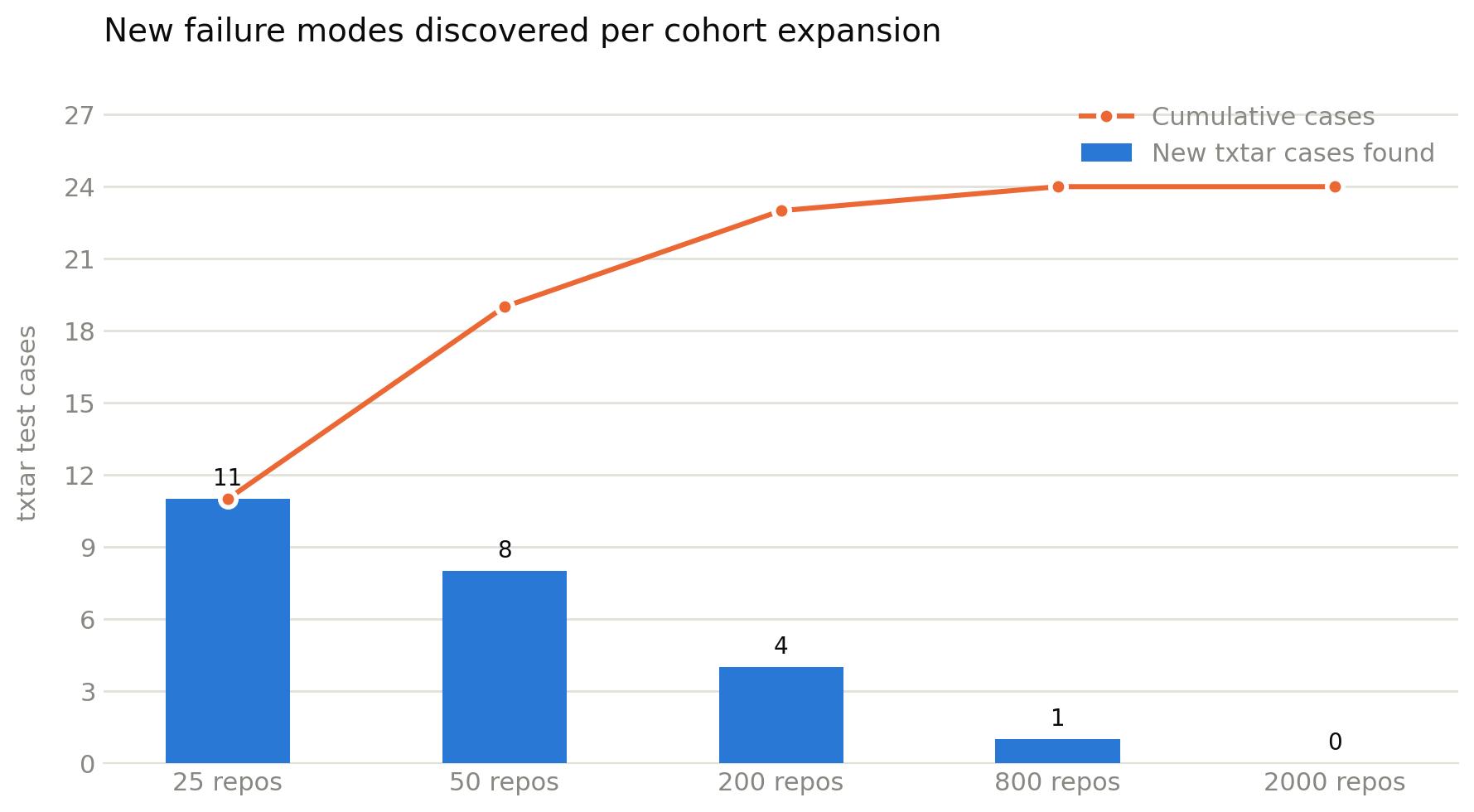
As the agent explores the space, it encodes new situations it finds as txtar tests, writes code to solve the expanded problem scope, verifies it first against the txtar test and then by attempting to send PRs to its test repository cohort, looking at failure and build logs, and re-assessing. When it reaches quiescence, it expands its test cohort exponentially.
When we applied this strategy to the vulnerability remediation problem, encoding the problem space as txtar texts, we found fewer and fewer new cases as we expanded the test pool:
Deterministic solution
The end result is a single program which can be run on a repository to deterministically upgrade dependencies to remediate vulnerabilities. And since it’s a program and not an LLM, we also benefit being able to audit its behaviour through normal source control history. Both the determinism and auditability increase confidence in its use in large scale changes considerably.
The other major benefit is cost and time: the program runs in <2s, and costs $0+a bit of CPU.
I ran a benchmark against 50 repositories, using the program in one test and an AI agent (Claude Sonnet 5, medium effort) in the other set, both tasked with remediating vulnerabilities. On average, the AI agent took ~50k1 tokens ($0.15/run) and 4m2/run. Across ~2000 of Go repos, that’s $750/run. We run this large scale change every 6h to remediate vulnerabilities quickly: that means we’d pay ~$0.66M/yr. At Google’s scale with 30x-40x those Go repos, that’s more like $20M/yr.
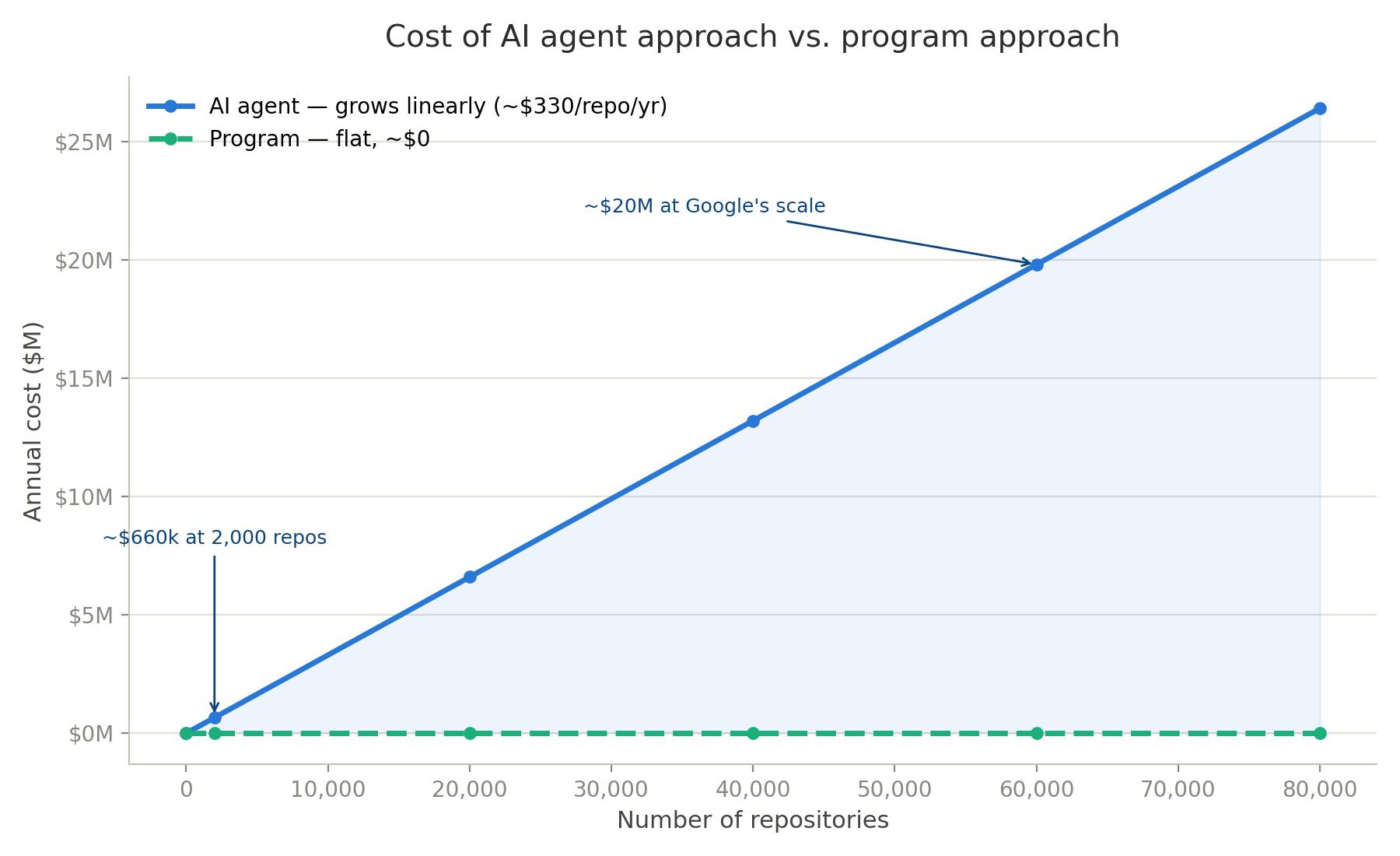
And, that’s a minimum: as developers 10x their velocity, they also 10x the repos they create, which 10x this cost. The program by comparison is ~$0 and will forever stay that way.
Long tail
There may be a long tail of issues to deal with. In the cases we’ve dealt with so far, this has not been the case, but it’s fair to imagine that there might be.
Of course, two simple solutions exist:
- Run an AI agent as a backstop.
- Keep the discovery loop infrastructure and allow long-tail findings to continually improve the program.
A better solution
It’s attractive to throw AI Agents at every problem, since they’re so fast at exploring problems at producing solutions. But in the case of LSCs, the way that you apply AI Agents makes a difference.
At Netflix we’ve had good success marrying the speed and ability of AI agents to explore the unknown, along with the observation that most LSCs have bounded problem spaces whose solutions are generically and mechanically expressable, to have AI agents create LSC programs.
The result is a solution that runs in seconds instead of hours, costs nothing instead of hundreds of thousands a year, behaves the same way on the nth repository as it did on the first, and can be reviewed the way we review everything else: by reading the source and the logs.