Graceful degradation with the logistic function
Graceful degradation with the logistic function
I recently worked on a server throttling feature in one of our build stack’s busiest binaries. We serve files from this binary, which is deployed as tens of thousands of tasks, which cumulatively serve millions of QPS.
Sometimes, one of these tasks gets a large memory spike. The cause for this is that the task is asked to hold a single file, and before it gets replicated, the file is needed by tens of thousands of peers, who all bombard the task with RPCs. Handling all these requests causes a huge spike in memory, and the task falls over.
Eventually replication catches up, and there are enough peers to spread the load. But we’d like to fail more gracefully than just OOM => death. We’d like to monitor the current and allocated memory, and gradually reject requests (throttle) when current memory exceeds allocated memory.
Abrupt degradation
A simple way to abruptly degrade is to reject requests above the allocated amount. We can model that with a simple step function. For the sake of example, let’s imagine that our allocated memory is 3GiB = 3221225472 bytes. We don’t want to hit 3GiB exactly, since that’s roughly where we’ll OOM, so let’s start throttling a bit before that: at 3000000000 bytes = 3e9 bytes (number chosen because it’s conveniently round, and close to 3GiB 🙂).
Here, 0 means “don’t reject”, and 1 means “reject”.
But, this is inefficient: we’re not using all our available memory. In a resource constrained environment, or when we’re highly scaled, we really want to squeeze every bit of memory that we can, and leaving a huge buffer untouched is far too wasteful.
Gradual degradation
It’s starting to sound like we need a linear function, not a stepwise function: something that rejects more and more requests the more memory we’re using. We now need a range to operate our throttler within: at the bottom of the range, we reject no requests; at the top, all requests.
Let’s define our range as [3e9 bytes, 3221225472 bytes], using the same bounds as our step function above.
So, let’s build a linear function for this. Note that the values that we want from our linear function are [0.0, 1.0]. As above, 0 means “don’t reject”, and 1 means “reject”. Any value between that represents that chance that a request will be rejected. That is, we’ll compare the result of our linear function against a number taken randomly from a uniform distribution of [0.0, 1.0].
To build this linear function, let’s start with what we know:
- Linear functions look like $f(x)=a \cdot x + b$
- $f(3e9)=0$
- $f(3221225472)=1$
We can use this to solve the equation:
\[\begin{split} 0 = a \cdot 3e9 + b\\ -b = 3e9 \cdot a\\ b = -3e9 \cdot a \end{split} \quad\quad \begin{split} 1 = a \cdot 3221225472 + b\\ 1 - b = a \cdot 3221225472\\ -b = a \cdot 3221225472 - 1\\ b = -a \cdot 3221225472 + 1 \end{split}\\ \text{ } \\ \text{ } \\ -3e9 \cdot a = -a \cdot 3221225472 + 1 \\ -3e9 \cdot a + a \cdot 3221225472 = 1 \\ a \cdot (-3e9 + 3221225472) = 1 \\ a = 1/221225472\]Now that we know a, let’s use that and either of the two partial solutions above to find b:
Our stepwise function accordingly gets an embedded linear function:
\[f(x) = \left\{ \begin{array}{ll} x/221225472 - 1953125/144027 & \quad x \ge 3e9 \\ 0 & \quad x < 3e9 \end{array} \right.\]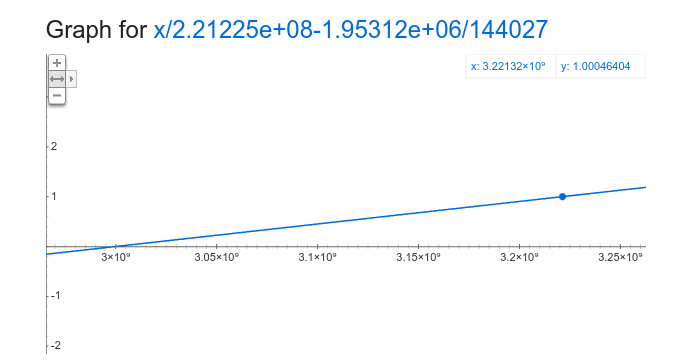
We can verify that this works by plugging in our original numbers:
\[\begin{split} f(x) = x/221225472 - 1953125/144027\\ f(x) = 3e9/221225472 - 1953125/144027\\ f(x) = 0 \end{split} \quad\quad \begin{split} f(x) = x/221225472 - 1953125/144027\\ f(x) = 3221225472/221225472 - 1953125/144027\\ f(x) = 1 \end{split}\\\]Linear function downsides
This is a lot nicer, but we can do better. If our binary is expected to consistently “run hot” (use most of its allocated memory), the linear function may be too aggressive.
Consider a binary that fairly consistently runs somewhere in the bottom 10-30% of the throttle memory range. A linear function will accordingly throttle 10-30% of requests. That’s expensive! Particularly if the incoming RPCs have a wide range of memory footprints: throttling 10-30% of requests when those requests may have negligible impact on memory is wasteful. And we can’t just make our memory range smaller. Doing so is dangerous: the smaller the range, the easier it is for a request to cause our memory to jump to the end of the range and OOM the process.
And, the second half of the linear function range is a problem too: it ramps up too slowly! When we’re 90% into our range, we’d like to be throttling most all requests, since it may only take a few expensive requests to jump right to the end and OOM the process.
We need to find a function with a better shape.
Graceful degradation
The logistic function has a better shape for server throttling.
Here’s the shape of the logistic function:
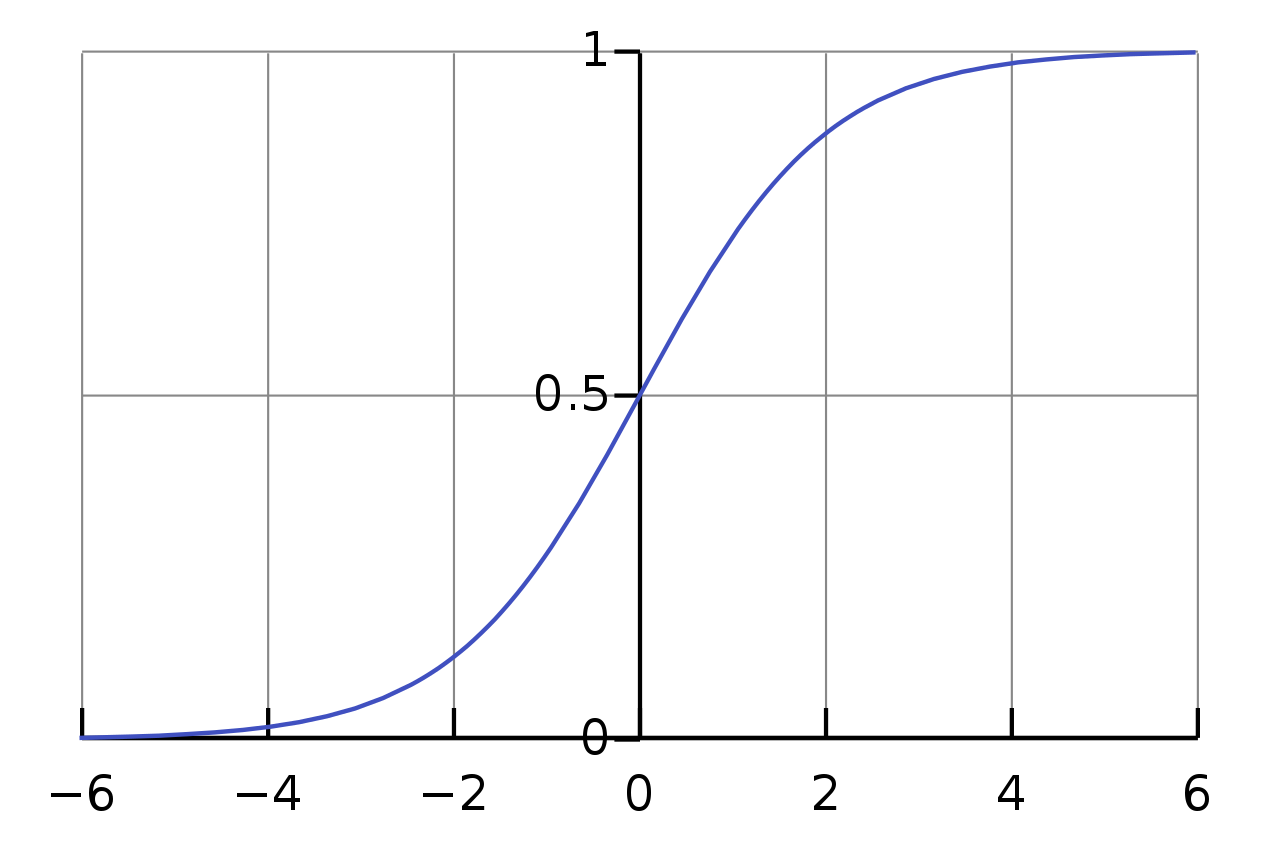
Its S-shaped curve allows more requests through when we’re at the bottom of our range, and aggressively throttles at the end of our range.
The equation for the logistic function is as follows,
\[\begin{align*} f(x) = \dfrac{L}{1 + e^{-k(x-x_0)}} \end{align*}\]Where,
- $x_0$ is the x value of the sigmoid’s midpoint
- L is the curve’s maximum value
- k is the logistic growth rate or steepness of the curve
Let’s adapt this to our problem:
L is the easiest: we want the maximum value to be 1 (we want our range to be [0.0, 1.0]), So, L=1.
$x_0$ is fairly straightforward: the midpont should be the midpoint between the start and end of our range. So,
\[\begin{align} x_0 = 3221225472-\left(\dfrac{3221225472-3e9}{2}\right)\\ x_0 = 3110612736 \end{align}\]Now we have,
\[\begin{align*} f(x) = \dfrac{L}{1 + e^{-k(x-x_0)}}\\ f(x) = \dfrac{1}{1 + e^{-k(x-3110612736)}} \end{align*}\]k is the hardest. Let’s start by solving for k in the equation above:
\[\begin{align*} f(x) = \dfrac{1}{1 + e^{-k\left(x-3110612736\right)}}\\ f(x)\left(1 + e^{-k(x-3110612736)}\right) = 1\\ 1 + e^{-k(x-3110612736)} = \dfrac{1}{f(x)}\\ e^{-k(x-3110612736)} = \dfrac{1}{f(x)}-1\\ -k(x-3110612736) = ln\left(\dfrac{1}{f(x)}-1\right)\\ k(x-3110612736) = -ln\left(\dfrac{1}{f(x)}-1\right)\\ k = \dfrac{-ln\left(\dfrac{1}{f(x)}-1\right)}{x-3110612736}\\ \end{align*}\]Now we return to what we know about how this curve should behave:
- $f(3e9)=0$
- $f(3221225472)=1$
Unfortunately, using either of these results in an unsolvable equation:
\[\begin{split} k = \dfrac{-ln\left(\dfrac{1}{f(x)}-1\right)}{x-3110612736}\\ k = \dfrac{-ln\left(\dfrac{1}{0}-1\right)}{3e9-3110612736}\\ \text{NaN: can't divide by 0} \end{split} \quad\quad \begin{split} k = \dfrac{-ln\left(\dfrac{1}{f(x)}-1\right)}{x-3110612736}\\ k = \dfrac{-ln\left(\dfrac{1}{1}-1\right)}{3221225472-3110612736}\\ k = \dfrac{-ln(0)}{3221225472-3110612736}\\ \text{NaN: natural log of 0 is undefined} \end{split}\]So, that’s a bummer. But it makes sense: the logistic function is asymptotic, with asymptotes 0 and 1: it will never actually reach those values!
So, let’s estimate k by choosing a value close to the asymptotes: either .01 for the lower bound, or .99 for the upper bound. It doesn’t matter which one we do, as the curve is reflected around the midpoint. So, let’s use the upper:
\[k = \dfrac{-ln\left(\dfrac{1}{f(x)}-1\right)}{x-3110612736}\\ k = \dfrac{-ln\left(\dfrac{1}{.99}-1\right)}{3221225472-3110612736}\\ k = \dfrac{-ln(0.0101010101)}{110612736}\\ k = \dfrac{4.59511985023}{110612736}\\ k = \dfrac{4.595119}{110612736}\\ k = .0000000415424043\]Great! Let’s put it all together:
\[\begin{align*} f(x) = \dfrac{L}{1 + e^{-k(x-x_0)}}\\ f(x) = \dfrac{1}{1 + e^{-.0000000415424043(x-3110612736)}} \end{align*}\]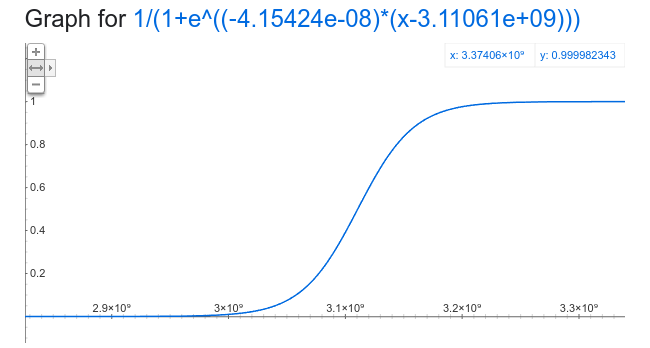
We can verify that this works by plugging in our original numbers:
\[\begin{split} f(x) = \dfrac{1}{1 + e^{-.0000000415424043(x-3110612736)}}\\ f(x) = \dfrac{1}{1 + e^{-.0000000415424043(3e9-3110612736)}}\\ f(x) = 0.01000000841 \end{split} \quad\quad \begin{split} f(x) = \dfrac{1}{1 + e^{-.0000000415424043(x-3110612736)}}\\ f(x) = \dfrac{1}{1 + e^{-.0000000415424043(3221225472-3110612736)}}\\ f(x) = 0.98999999158 \end{split}\\\]Since we’re approximating values and will never reach 0 or 1, it’s helpful to continue using the stepwise function to guarantee no throttling when we’re below our threshold, and to always throttle when we’re above our allowable range:
\[f(x) = \left\{ \begin{array}{ll} 1 & \quad x \ge 3221225472 \\ \dfrac{1}{1 + e^{-.0000000415424043(x-3110612736)}} & \quad 3e9 \le x < 3221225472 \\ 0 & \quad x < 3e9 \end{array} \right.\]Implementing logistic function server throttling
Implementing server throttling with the logistic function is fairly straight forward, adding another positive to its list of positives:
// This example written in Go. It uses RPC semantics, like protobufs and
// google.golang.org/grpc/status, but the tools don't really matter. http or any
// other communication protocol works as well.

func (c *Client) HandleSomeRPC(ctx context.Context, req *mypb.Request, resp *mypb.Response) error {
  if shouldThrottle(currentMemoryBytes(), allocatedMemoryBytes(), throttleRangeBytes()) {
    return status.Error(codes.ResourceExhausted, "out of memory - try again later")
  }
  // ...
}

func shouldThrottle(currentMemoryBytes, allocatedMemoryBytes, throttleRangeBytes uint64) bool {
	if currentMemoryBytes < allocatedMemoryBytes-throttleRangeBytes {
		return false
	}
	if currentMemoryBytes > allocatedMemoryBytes+throttleRangeBytes {
		// Relevant if your process is in a scenario where max available memory
		// is greater than max allocated memory (shared containers etc).
		return true
	}

	x := currentMemoryBytes
	x0 := allocatedMemoryBytes - (uint64)(throttleRangeBytes/2)
	L := 1.0
	k := (-1 * math.Log((L/.99)-1)) / (float64(allocatedMemoryBytes) - float64(x0))

	// y1 is probability (0.00-1.00) which we roll against to determine whether
	// to throttle or not. When it is 0, we never throttle (memory below allowed
	// exceed). When it is 1, we always throttle (memory above allowed exceed).
	y1 := L / (1.0 + math.Exp(-k*(float64(x)-float64(x0))))

	// y2 is a number between 0 and 1 to compare against y1.
	y2 := rand.Float64()

	return y2 <= y1
}
Conclusion
At tremendous scale, it’s important to eke every last bit of memory from servers. It’s also important to be able to gracefully degrade during memory spikes, to avoid out-of-memory crashes. The logistic function is an excellent function for deciding whether to throttle requests, which strikes a good balance between the competing priorities of using all available memory and avoiding out-of-memory crashes.